Can a Roller Shade Be Wider Than the Fabric Roll?
Can a Roller Shade Be Wider Than the Fabric Roll?
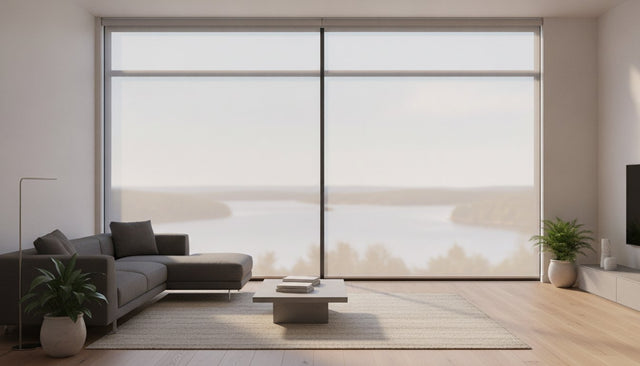
Large windows often require a different roller-shade design than standard-size windows. One of the main limitations is the width of the selected fabric roll.
A roller shade normally cannot be manufactured as one seamless shade when the required finished width is greater than the usable width of the fabric.
Although some fabrics can be turned sideways through a process called railroading, this is usually not the preferred solution. For many large windows, a more practical option is to divide the opening into two, three, or four separate shades on one coordinated headrail.
Save On Blinds can offer:
- Two shades on one headrail
- Three shades on one headrail
- Four shades on one headrail
The fabric breaks can be measured to line up with window mullions, door frames, or other natural divisions in the glass.
What Limits the Width of a Roller Shade?
Roller-shade fabrics are manufactured in fixed roll widths. Common widths vary by fabric collection and supplier.
However, the listed fabric-roll width is not always the maximum finished shade width. The manufacturer must also allow for trimming, fabric alignment, hardware, and operating clearances.
The maximum size of a roller shade depends on:
- Fabric-roll width
- Shade height
- Fabric weight
- Roller-tube strength
- Bottom-bar weight
- Manual clutch or motor capacity
- Bracket design
- Fabric stability
A very wide, short shade may be possible, while the same fabric may not be approved at that width for a taller window.
Can the Fabric Be Turned Sideways?
Turning roller-shade fabric sideways is known as railroading.
In a standard shade, the fabric-roll width becomes the width of the finished shade. With railroading, the fabric is rotated so the original roll width becomes the height of the shade.
This can sometimes allow a shade to be wider than the fabric roll, but it may create appearance and performance concerns.
Why Railroading Is Usually Not Recommended
The Fabric May Not Hang Correctly
Many roller fabrics are designed to roll and hang in one direction.
Turning the material sideways may contribute to:
- Edge curl
- Rippling
- Bowing
- Uneven rolling
- Fabric tracking problems
- A bottom bar that does not remain level
A fabric that performs well in its intended direction may behave differently when rotated.
The Texture or Pattern May Change Direction
Some fabrics have a visible weave, rib, pattern, or texture.
Railroading can rotate that pattern by 90 degrees. The result may look different from the sample or from other shades in the same room.
A Seam May Be Required
If the shade is wider than the usable length of the railroaded material, two fabric pieces may need to be joined.
The seam can become visible, particularly when sunlight passes through the shade.
A seam may also:
- Affect how the fabric rolls
- Create a line across the shade
- Be more noticeable on solar or light-filtering fabrics
- Become a weak or less flexible area
- Reduce the clean appearance of the finished shade
Very Wide Shades Are Heavy
A large roller shade requires more fabric, a longer tube, and a wider bottom bar.
A shade may be technically possible but still be difficult to operate or service.
Wide Fabrics Can Track Unevenly
As a shade rolls upward, the fabric must remain centred on the tube.
A very wide or railroaded shade may be more likely to telescope, meaning the fabric gradually shifts toward one side.
For these reasons, railroading should generally be treated as a specialty exception rather than the first choice.
A Better Option: Multiple Shades on One Headrail
For many large windows, the better solution is to divide the opening into multiple roller shades.
Save On Blinds can provide two-on-one, three-on-one, or four-on-one configurations.
Each shade uses its own roller and fabric panel, while the overall system is designed to create a coordinated appearance across the window.
This allows the fabrics to remain within their approved size limits without requiring railroading or seams.
What Does Two-on-One Mean?
A two-on-one system uses two separate roller shades under one coordinated headrail, cassette, or fascia arrangement.
This configuration is commonly used for:
- Two-panel windows
- Sliding patio doors
- Picture windows with a centre mullion
- Wide windows exceeding the fabric-roll width
Each shade can normally be operated separately. With motorization, they may also be grouped to move together.
Three-on-One and Four-on-One Systems
Larger openings may require three or four shades.
Each shade can correspond with a separate section of glass.
Aligning the Fabric Breaks With the Window
Separate roller shades require a narrow space between the fabric panels.
This space is necessary because each shade has its own roller, brackets, controls, and fabric clearance.
The best way to reduce the visual impact of these gaps is to place them over the natural breaks in the window such as mullions, frames, rails etc
Save On Blinds can measure each shade so the fabric breaks line up as closely as possible with these architectural divisions.
This creates a cleaner appearance than simply dividing the total width into equal sections.
The Shades Do Not Need to Be Equal Widths
Many large windows have glass panels of different sizes.
The goal is to match the window layout rather than make every shade identical.
Benefits of Multiple Shades
Better Fabric Performance
Each shade remains within the intended fabric width and product-size limitations.
Easier Operation
Several smaller shades are generally easier to operate than one oversized shade.
Manual systems require less force, and motorized shades may use smaller motors.
Independent Light Control
Each shade can be raised or lowered separately.
This allows you to:
- Open the shade over a patio door
- Leave the fixed-panel shade closed
- Block sunlight on only one side
- Keep part of the outdoor view
- Adjust the shades as the sun moves
Easier Service and Replacement
Smaller shades are easier to transport, install, remove, and repair.
If one fabric panel is damaged, the entire window-covering system may not need to be replaced.
Will There Be Gaps Between the Shades?
Yes. Separate shades require a small gap between adjacent fabrics.
The gap usually cannot be eliminated completely.
However, positioning it over a mullion or window frame makes it less noticeable and limits the amount of visible glass.
For rooms requiring maximum darkness, additional drapery may help cover the fabric breaks.
Can Multiple Shades Be Motorized?
Two-on-one, three-on-one, and four-on-one systems may be available with motorization, depending on the product dimensions and hardware.
Motorized shades may operate separately or together.
Motorization can be especially convenient for tall or frequently adjusted windows.
Final Recommendation
A roller shade normally should not be manufactured wider than the usable width of the selected fabric roll.
Railroading may be possible with some fabrics, but it can create problems involving pattern direction, seams, edge curl, weight, and fabric tracking.
For most large windows, the better solution is to divide the opening into multiple roller shades.
Save On Blinds can provide two-on-one, three-on-one, or four-on-one roller-shade systems, with fabric breaks measured to align with window mullions, patio-door frames, or other natural divisions.
This approach provides more reliable fabric performance, easier operation, better light control, and a cleaner fit for large windows.
Find the Right Roller-Shade Configuration
Save On Blinds offers custom roller shades in a range of fabrics, colours, control systems, and motorized options.
Because maximum sizes vary by fabric and hardware, large openings should be reviewed before ordering.
Explore custom roller shades at SaveOnBlinds.com and choose a configuration designed around the size and structure of your window.